I came home last night from a New Year’s Eve party to something that felt deeply wrong.
My house was hot. Not just warm. Uncomfortably, unbearably hot.
The first thing I did was walk over to my ecobee thermostat. The display showed 20.5°C, which seemed perfectly reasonable. But the furnace was running full blast. That did not add up.
I checked another temperature sensor I keep in the kitchen. It was showing over 26°C.
At that point I assumed the ecobee itself was faulty. But when I opened the app, I finally saw the real problem.
The Mystery of the Competing Temperatures
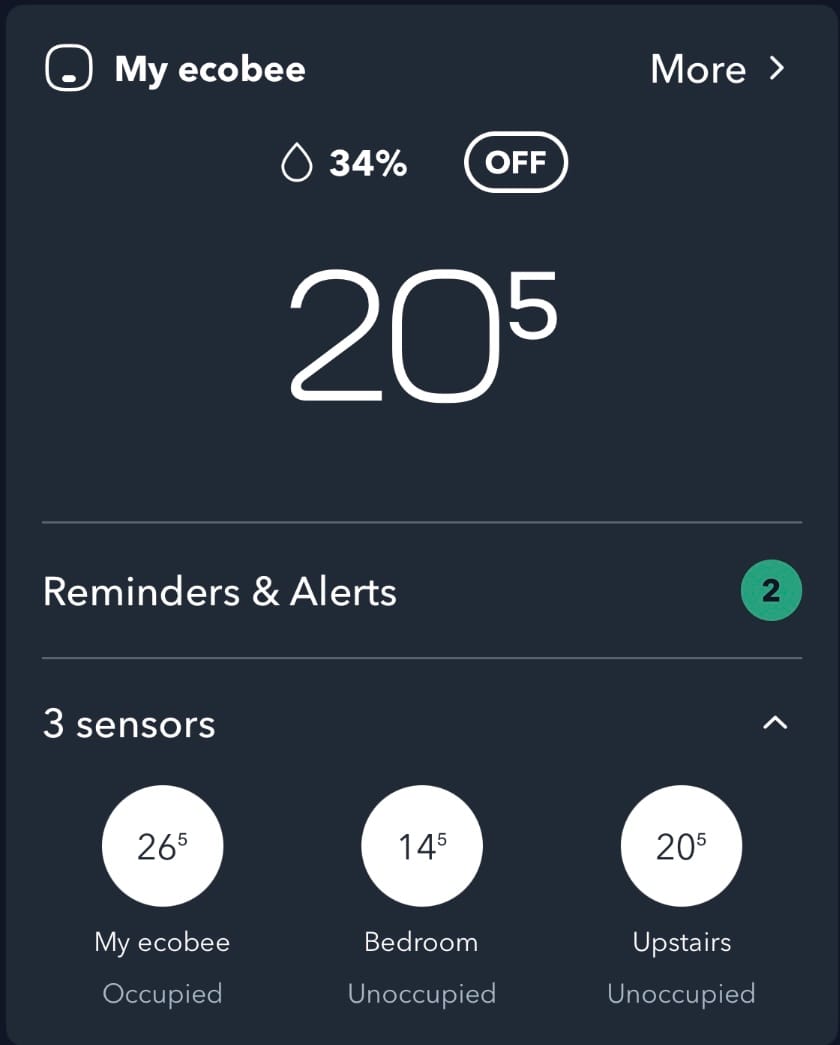
In the ecobee app, the main thermostat was actually reporting 26.5°C. The 20.5°C I saw on the wall unit was just the target temperature.
The real issue was coming from one of ecobee’s SmartSensors. According to the app, that sensor was reporting 14.5°C.
If you are not familiar with them, SmartSensors are designed to solve a common problem in homes. Most houses have a single thermostat on the main floor, which means other areas like basements or bedrooms often end up too cold or too warm. The sensors provide extra data points so the thermostat can adjust heating or cooling more intelligently across the house.
In theory, it is a great idea.
In practice, it almost cooked me alive.
How One Sensor Turned My House Into a Sauna
I live in a backsplit. The master bedroom was added after the house was built, so there is no basement underneath it and only a single heating vent feeding the room from what used to be an exterior wall. As a result, that bedroom normally runs 2 to 3 degrees colder than the rest of the house.
But 14.5°C was wildly wrong.
What actually happened is embarrassingly simple. At some eariler in the day, the SmartSensor had been knocked off the nightstand and ended up flat on the floor. The floor in that room is much colder, and the sensor dutifully reported what it felt.
Rather than questioning that reading, the ecobee system treated it as perfectly valid. It believed one room in my house was 6 degrees colder than everything else and did everything it could to bring that room “back in line.”
That meant running the furnace continuously while the rest of the house quietly transformed into a tropical resort.
I do not know how long it would have continued like that if I had not come home when I did. I do know my next heating bill would have been painful.
The Software Lesson Hidden in the Heat
This is not really a story about thermostats. It is a story about software.
ecobee had a smart idea. Add more sensors. Collect more data. Make better decisions.
But they clearly did not account for edge cases like:
- A sensor falling on a cold floor
- A sensor being placed near a draft or window
- A sensor being buried under laundry or pillows
- A sensor being temporarily exposed to abnormal conditions
When software blindly trusts sensor input without sanity checks, it stops being smart and starts being dangerous, expensive, or both.
A few lines of business logic could have prevented this entirely. Something like:
- Ignore readings that suddenly diverge far beyond normal variance
- Require sustained abnormal readings before taking major action
- Flag impossible conditions for user confirmation
Instead, the system took one bad data point and confidently turned my home into a giant sauna.
The Takeaway for Anyone Building “Smart” Systems
Do not blindly trust your inputs.
Sensors lie. They fall. They get bumped. They get cold. They get covered. They fail in strange and creative ways.
Your software must assume that will happen.
If you are building anything that reacts to the physical world, especially systems that control money, safety, comfort, or infrastructure, your edge case handling is not optional. It is the product.
Because if you do not design for the weird cases, your “smart” system eventually becomes the dumbest thing in the room.
And sometimes, the hottest.
Comments